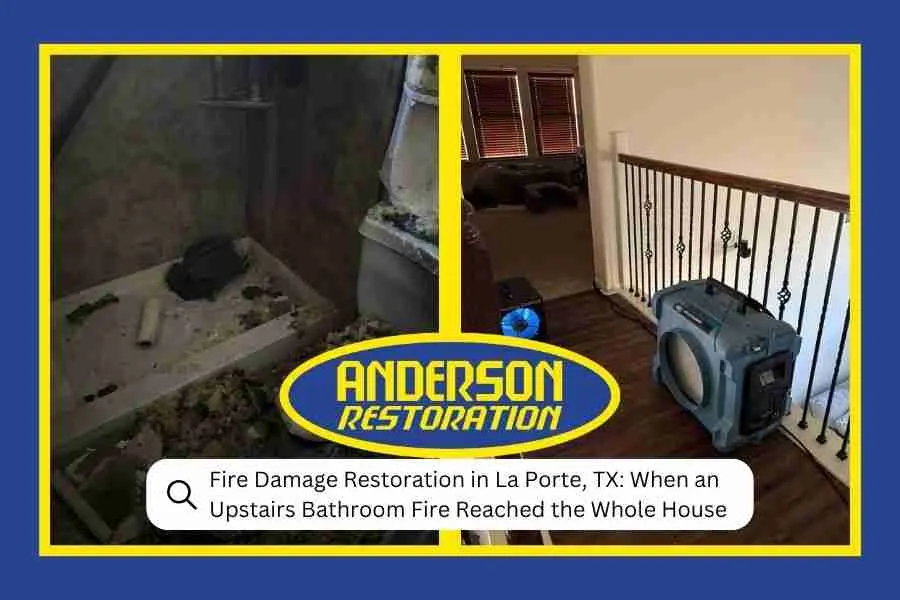
A fire in one upstairs bathroom left soot on nearly every surface of this two story La Porte home. Our crew at Anderson Restoration ran the fire damage restoration start to finish. That covered the first walkthrough, the demolition, the cleanup, and every wiped handrail in between. We have handled fires here since 2002.
What an Upstairs Bathroom Fire Does to a Whole House
Fire damage almost never stops at the room where it started. Flames ate through the bathroom ceiling and into the wall cavity. Charred insulation, burned drywall and scorched fixtures dropped straight into the shower pan. The rest spilled out across the hallway floor.
The homeowners came back to a room they barely recognized. Gray soot covered the vanity, and a chalky film sat on countertops and personal items, left behind by the crew that put the fire out.
That part catches people off guard. What stops a fire leaves a mess of its own.
 |  |  |  |
The origin room on day one: burned insulation, an open ceiling cavity, and debris in the shower pan.
How We Found Out How Far the Smoke Traveled
We mapped the smoke damage with dry chem sponges before touching anything else. A chem sponge is a soft rubber block that lifts soot off a surface without smearing it. Our crew wiped test spots in every room. Handrails, stair treads, sink surrounds, a media console and a bedroom dresser all came back black.
That test tells us where the job actually ends. Soot is greasy and very fine. It rides warm air into rooms that never saw a flame.
Skip that mapping step and you leave contamination sitting behind walls and inside fabrics, which is exactly why some houses still smell like smoke six months later. The IICRC S700 standard for fire and smoke restoration treats that documentation as step one, not paperwork.
Clearing the Air and Pulling Out What Could Not Be Saved
Air scrubbers and hydroxyl generators went in before any demolition started. Air scrubbers pull soot particles out of the air through HEPA filters, while hydroxyl generators break down the odor molecules behind that burnt smell. We staged both on the landing and upstairs.
A dehumidifier ran at an opened laundry wall too. Fire crews use a lot of water, and it soaks into framing and insulation. Drying that out is real water damage restoration work. Rush past it and you trade a fire job for a mold job.
Then came demo. Charred insulation, ruined drywall and burned finishes came out and got hauled from the hallways. Every affected wall and ceiling got opened back to sound framing.
 |  |  |  |
Air scrubbers, hydroxyl generators and a dehumidifier running as damaged materials came out.
Cleaning Soot Off Everything the Fire Never Touched
Most of this house got cleaned, not rebuilt. With the damaged materials gone, our crew worked surface by surface with chem sponges: sink surrounds, the stair handrail, a media console, the dresser by the front door. Saving a finish beats replacing it, and it keeps the claim smaller.
Some pieces are too fragile or too heavily coated to clean in place. Those go out through our content packout services, where they are inventoried, cleaned off site and stored until the house is ready for them.
 |  |  |  |
Chem sponge work on a sink surround, the stair handrail, a media console and the entry dresser.
What We Tell Homeowners in the First Week After a Fire
The first week after a fire shapes how much of a home can be saved. Soot is acidic. Left alone, it etches metal, stains grout and sets into fabric. Moving fast keeps a cleaning job from turning into a replacement job.
Four things worth doing right away
- Do not wipe soot with a wet rag, because water only smears it deeper into the surface.
- Leave the HVAC system off until someone checks the ducts.
- Photograph every room before anything gets moved or thrown out.
- Ask your contractor what stays and what goes, and get that list in writing.
The USFA guide After the Fire: Returning to Normal is a solid read for those first few days. On our side of the work, we have written up the fire restoration process step by step, the signs a home needs fire damage repair, and the hidden costs that show up on fire projects.
Fire and Smoke Damage Questions We Hear Most
Most fire questions come down to three things: the smell, the money and the belongings. Here is how we answer them on site, in La Porte and across the rest of the Houston metro. Every house is different, but the patterns hold.
How long does smoke odor last after a house fire?
Untreated smoke odor can hang around for months, and Houston humidity makes it worse. The smell usually clears once the contaminated materials are out and every surface has been cleaned.
Does homeowners insurance cover fire and smoke cleanup?
Fire is a covered peril on most standard homeowners policies, so cleanup and repairs are generally included. Limits and deductibles vary. We work with your carrier directly and document each room as we go, which keeps disagreements rare.
Can furniture and electronics be saved after a fire?
A lot of it can. Wood, metal and glass usually clean up well with dry sponge work, as this job showed. Electronics and textiles go out to a specialty partner, since soot inside a device needs a different approach.
Had a Fire? We Can Be There Today.
Anderson Restoration is family owned, IICRC certified and on call 24/7 across the Houston metro. We inspect, document, clean and rebuild, and we handle your insurance carrier directly.